- Employer Resources
- |
- Last Updated: March 26, 2026
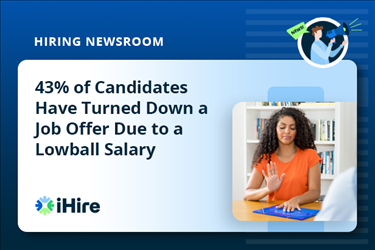
43% of Candidates Have Turned Down a Job Offer Due to a Lowball Salary – iHire Survey
Imagine you’ve finally found the perfect candidate who checks all the boxes for job qualifications and requirements. You make an offer, thinking they’re just a signature away from joining your team.
But, alas, that ideal candidate turns you down, as the salary was not what they expected.
They decide to look for another job elsewhere (maybe with your competitor), sending you back to the drawing board to find the right new hire.
This frustrating scenario is common in the recruiting world, as confirmed by our recent survey. In a March 2026, iHire polled 642 U.S. job seekers from 57 industries, asking, have you ever declined a job offer because the employer could not meet your salary expectations?
As shown in the chart below, 43% of respondents said “yes,” they had declined an offer, compared to 48% who said “no.” Meanwhile, 7% were unsure of their response, and 2% chose not to answer.
Have you ever declined a job offer because the employer could not meet your salary expectations?
With more than 1 in 3 job seekers admitting to declining job offers due to a lowball salary, preparing for these sticky situations will keep your hiring processes running smoothly. Read on to learn what to do if a candidate turns you down – from how to react and when to counteroffer.
What to Do If a Candidate Rejects Your Job Offer
When your top choice rejects your offer, your first reaction is likely disappointment or aggravation, but you’ll need to remain calm and professional. Thank the candidate for their time and ask for a quick phone call to discuss their decision.
During this conversation, pose the right questions to understand their exact reservations.
Is the base pay too low? Did a competitor offer better benefits?
Gathering this honest feedback helps you determine your next move. It also highlights areas where your current hiring process might need improvement.
Negotiating Salary: When to Counteroffer and When to Walk Away
If the candidate is open to a discussion, you enter the salary negotiation phase.
Listen carefully to their financial expectations and career goals. Compare their desired number against your budget and the true market value of the open role. If they possess rare skills that will immediately benefit your business, extending a salary counteroffer is often a smart investment.
When you make a salary counteroffer, be clear and direct with the applicant. Present the new figure and explicitly state if it is your best and final offer. This prevents an endless cycle of negotiations and sets clear professional boundaries. It shows you value their talent while still protecting your bottom line.
If the candidate demands a number that breaks your budget, you have to walk away and focus on other applicants (more on that in the next section). Paying a new hire significantly more than your current loyal employees creates resentment and retention problems (this is called pay compression).
Politely withdraw from the negotiation if their demands remain too high. Wish the candidate the best in their career journey and thank them again. Ending things on a positive note protects your employer brand and leaves the door open for future possibilities.
Contingency Planning for Hiring
Sometimes a candidate declines job offer terms entirely and walks away without negotiating. When this happens, you need a strong contingency plan to keep your business moving forward. Your first step should be looking at the runner-up candidates from your recent rounds of interviews.
If you had a strong second place finisher, reach out to them immediately. But first, review your initial salary range before you extend the next offer. If your first choice rejected the pay, your second choice might feel the same way. Adjust the numbers slightly if your budget allows to ensure a quick acceptance.
If you do not have a runner-up ready to go, turn to your broader talent pipeline. Review past applicants who showed promise but were not the right fit for previous roles. Reconnecting with warm leads saves you the time and expense of starting a new search.
If you must post the job ad again, tweak the details based on the feedback you received from the now-former candidate. Highlight the most attractive parts of your company culture to draw in applicants who align with your budget. A fresh job posting with updated details can attract a new wave of qualified professionals.
Your Next Hire Awaits
Find Qualified Talent In Your Industry

We Value Your Privacy.
Determining the Right Compensation Strategy
The best way to prevent candidates from declining job offers is to start with a solid compensation strategy in the first place. You want to offer highly competitive pay from the very beginning. Guessing what a role is worth will only lead to rejected offers and wasted recruitment time.

Conduct Market Research and Benchmarking
Start by researching current market rates for your specific job titles. Look at what your direct competitors pay for similar roles in your industry and location. Conducting a thorough compensation benchmarking study gives you the hard data you need to set realistic pay bands.
Pay rates change frequently based on economic shifts. Using recent data ensures your offers remain highly competitive in today’s market – and don’t forget to account for the cost of living. If you need assistance in determining the right pay scales, consulting a third-party HR expert can be highly beneficial.
Understand the Benefits of Salary Transparency
Including a clear salary range in your job postings is a powerful tactic for attracting the right talent – it sets expectations before the candidate ever submits their resume. In fact, 57.1% of job seekers are more likely to apply for a job when the posting indicates a salary range.
Many states and cities now have strict salary transparency laws in play. Listing salary ranges keeps your business compliant with local regulations. It also weeds out candidates who require a salary far above your budget, saving you time during the interview stage.
Pitching Your Total Compensation Package
Base pay is crucial, but it is not the only thing candidates care about. You must present your offer by highlighting your total compensation package. This includes health insurance plans, retirement matching, paid time off, and flexible scheduling options.
Make sure the candidate truly understands the financial value of these extra offerings. Provide a detailed document that breaks down the monetary equivalent of their complete benefits. A robust total compensation package can easily persuade a candidate to accept your offer, even if the base salary is lower than they originally wanted.
What Job Candidates Want in a Total Compensation Package
In our survey, we also asked candidates an open-ended question, what could an employer offer that would make you accept a job for a lower salary? Here is a small sampling of the wide range of benefits and perks – all part of a total compensation package – they shared to give you an idea of what job candidates value most:
- Flexibility in work hours
- Work-life balance
- Job security
- Unlimited PTO
- Excellent healthcare
- Quality time with family
- Weekends and holidays off
- Hybrid work schedule
- Relocation package
- Stock options
- Mental health benefits
- Fully remote work
- Strong learning opportunities
- Meaningful responsibilities
- Long-term growth potential
- Tuition reimbursement
- Uncapped commission
- Shorter work week
- Yearly salary increases
Find the Right Hire for the Right Pay
Losing a great candidate over money is always frustrating. However, building a strong strategy prepares you for whatever the hiring market throws your way. By researching market rates, embracing transparency, and highlighting your complete benefits, you will attract and retain the perfect new hire for your team.
Get started searching for your next hire by creating a free iHire account or signing into your existing one. You can also browse our Employer Resource Center for more compensation, benefits, and hiring advice.

Originally Published: March 26, 2026
RELATED RESOURCES


Hiring? You're in the Right Place.
- Reach unique talent: 51% of our candidates aren't using other job boards
- Connect your ATS and get 6x more applications with iHire's apply process
- Get matching candidate resumes sent straight to your inbox
We Value Your Privacy